
 We started our week at Rocky Point (as it turns out a very descriptive name) and we made our way via Steep Ravine Canyon (as it turns out an even more descriptive name) to join the Shoreline Highway. The Shoreline Highway is an old friend of ours and has been with us - in one persona or another - since the start of our journey. Sometimes it is State Route 1, sometimes Highway 101. Sometimes it is Pacific Coast Highway, sometimes it is Cabrillo Highway. It changes its name with the frequency of a petty fraudster, but today it is the Shoreline Highway and it is taking us north. One of the first places we came upon was Red Rock Beach which turns out to be the most popular nudest beach north of San Francisco. I tried to hurry Amy on and exchanged witty repartee with her in order to try and avert her attention from the lobster-pink bodies in the near distance. We stopped to read a copy of the Nudist Beach Etiquette Rules and I pointed out to Amy Rule 3 which states "If you're sunbathing nude in a secluded area, leave a bathing suit on a rock to let others know they are approaching an unclothed person. If you're uncomfortable having your suit out of reach, bring a spare". Amy found all this quite bizarre and wanted to know whether she should leave the Bow and Fur Leather Coat she bought at Diggidy Dog in Carmel lying around just in case. I told her not to be so silly and we hurried on.
.
 Very soon we came to Stinson Beach. Here we found over three miles of sandy beach, a 51 acre park, 100s of picnic tables and a snack bar. To our surprise, we also found William Shakespeare. Each year, Stinson Beach gives itself over to the Shakespeare at Stinson Festival and our journey up the beach coincided with a production of the Taming of the Shrew. Amy - who considers herself to be a logical dog - could not understand why, earlier in the day, I had found the sight of a few naked sunbathers uncomfortable whilst, a few miles further north, I could walk passed a group of eccentrics dressed in 16th century costumes and shouting strange insults at one another without batting an eyelid. What she didn't realise was that I was rushing her onwards for, as far as I can remember, there wasn't a part for a dog in the play. One might be tempted to ask why Shakespeare at Stinson Beach? "Why not" those Bard-loving citizens of Northern California would reply.
 Towards its norther extremity, Stinson Beach provides a natural bar which stretches out across Bolinas Lagoon. However, it is impossible to walk all the way to the small town of Bolinas without getting your feet very wet. Amy pointed out that in her case it would be her feet, her legs, her tummy and her head, so we turned back and followed the road which runs up the east side of the lagoon. There is some nice little beach houses here and for a few moments Amy and I dreamed. Despite our best efforts we couldn't dream up a way of affording the $4,000 a week rental and therefore we walked on.
Bolinas Lagoon is almost the last point at which you can see the distant towers of San Francisco. We were about to say goodbye to big-city life for the best part of a year. We turned our respective backs on city-scapes and bade a hearty welcome to gulch-country. As you follow Balinas Lagoon to the north there are an awful lot of gulches. Within just a few miles there's Wilkins Gulch, Pike County Gulch, Morses Gulch, McKinnan Gulch, Cronin Gulch, and Copper Mine Gulch to name just a few. Amy asked me what a gulch was, which under the circumstances was quite a reasonable question. I quoted her the standard dictionary definition - "A narrow rocky ravine with a fast-flowing stream running through it" - and she pointed out that none of the so-called gulches had any streams in them. At that very moment we were passing a sign pointing towards "Flying Pig Ranch". Not everything is what it says it is, I replied. She didn't reply. She was too busy looking up into the sky for a passing bacon sandwich.
 Leaving Bolinas Lagoon behind, the Shoreline Highway, Amy and I cut up through the hills until we eventually reached the town of Olema. With a population of 55, Olema is now a sizeable town on our route and therefore worthy of full investigation.
 The town takes its name from the Miwok Indian word for coyote. The town reached the zenith of its fame and fortune in the mid nineteenth century when it became a popular place for workers in the booming logging industry to relax. There were numerous saloons and establishments of even lesser repute. It would never grow bigger. As the logging industry faded so did the fortunes and notoriety of Olema. Today it is a sleepy little place with a handful of shops and houses. It is also the place where the Shoreline Highway meets up with Sir Francis Drake Boulevard. If Amy was surprised to see this archetypal English name out here in the hills of California she did not give it away. By contrast I was intrigued until I discovered that Drake is supposed to have landed on the beach just down the road with the crew of the Golden Hind during his voyage around the world. "It's a small world", I said to Amy. "Wuff", she replied.
 We ended the week at the Olema Inn. Whilst genuinely old, the Inn has none of the dubious attributes of those earlier Olema saloons. In fact it is quite a refined place : "a gateway for simple indulgences and small luxuries where you can dream away your cares and escape your troubles". For her simple indulgence, Amy had a plate of chicken. For my small luxury I had a bottle of the 2002 Beckmen Vinyards Marsanne Santa Ynez Valley : a snip at just $31. Ah the simple pleasures of life.


 We were now back on the Pacific coast and we going to follow the coast north for the rest of the week. What roads there are tend to have an off-on affair with the coast, sometimes they will come close, sometimes they shun the sea as and hide in the twisting valleys. We followed paths across the bare hills, keeping close to the coast and knowing that would eventually take us to Muir Beach.


 All you can do is to make a drunken bee-line to one or two places you particularly want to see and leave the rest to the next time you virtually pass by. Thus Amy and I called in for a pint of Guinness at


 However we had only just scraped the surface. We had covered just one-tenth of the total distance from Los Angeles to New York (via Seattle). We needed to be in this in the long-term.


 San Bruno mountain is a shock. You don’t expect it. Right in the middle of the urban sprawl that is San Francisco there is this dirty, great big mountain. Amy and I were halted in our tracks. We looked at each other but didn’t need to speak. We both knew what we were going to do. We were going to climb it.


 As we walked along the streets and paths of Foster City, Amy remarked on the relatively few dogs she had seen. I had to point out to her that there were strict local ordinances on the maximum number of dogs or cats that could be kept per household. She said something like "fascist state", but it could have been "lick-slurp" : there were a lot of noisy speedboats chugging along the waterways.


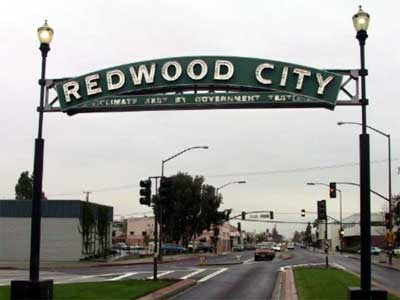 At some point during the week we passed through Redwood City. The only thing I can recall is a large sign which proclaims the name of the city and the its’ slogan : “Climate Best by Government Test”. Intrigued, I checked out the scientific basis of this claim. It would appear that in the early years of the twentieth century, a joint survey was undertaken by the American and German governments to identify the place with the best climate in the world. Why they should want to do this is anyone’s guess – perhaps they were working out where to invade next – but, it appears that Redwood City, California shared joint first place along with the Canary Islands and North Africa! As a USP (unique selling point) the claim seems somewhat tenuous and Amy intimated as much. “What else is there to say about the place?”, I replied.
